Telluric sites are natural locations where the Earth's structure is directly visible and strongly influences perception. Mountains, rock formations, megalithic sites and volcanic landscapes are often described as powerful places or energy locations due to their mineral density and geological dominance.
These places are sometimes interpreted as nodes of invisible energy — linked to ley lines, Earth currents or cosmic alignments.
Yet behind these interpretations lies a deeper and more fundamental reality: geology, mineral structure and landscape architecture.
This page is a complete, encyclopedic exploration of telluric sites — from scientific foundations to cultural beliefs, from measurable terrain structure to centuries of interpretation.
The term telluric originates from the Latin tellus, meaning Earth. In scientific usage, it refers to phenomena that originate from the ground: electrical currents, geological processes, or magnetic interactions.
However, the expression telluric site is not a formal scientific category. It is a descriptive term used to characterize locations where the Earth itself becomes visually and physically dominant.
A telluric site is therefore not defined by belief — but by structure.
In such environments, the ground is not hidden beneath soil — it is revealed as mineral mass.
This visibility of the Earth’s structure is what produces the impression often described as “energy”.
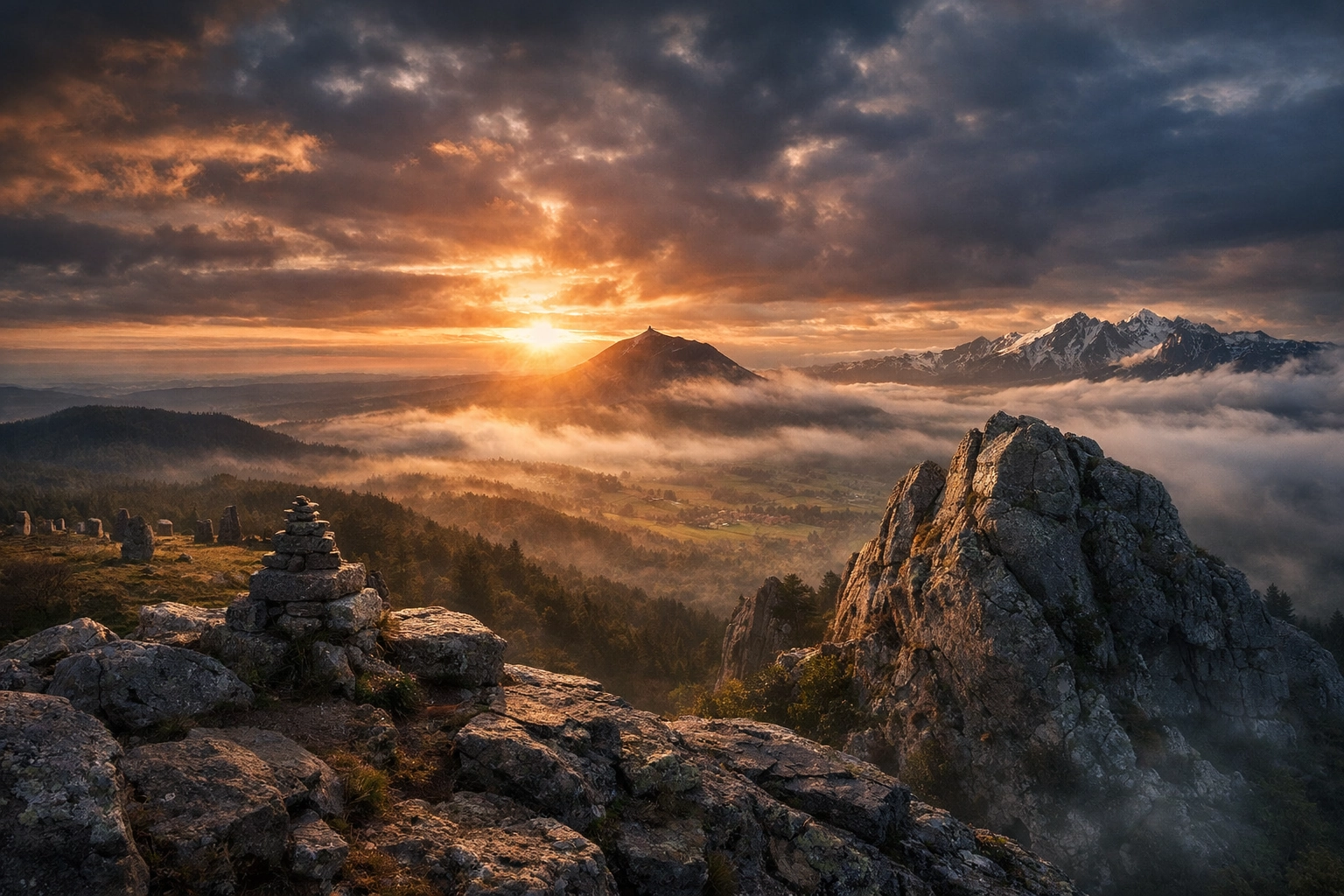
A telluric site is a natural place where the Earth’s structure is clearly visible and strongly influences how the landscape is perceived. These locations often include mountains, rock formations, volcanic areas, or megalithic sites.
They are typically associated with exposed stone, strong relief, and a powerful visual presence — which explains why they are often described as “energy places”.
A telluric site is a place where geological structure is highly visible, with exposed rock, strong relief and minimal environmental masking. These locations often create a strong perception due to mineral density and landscape openness.
The concept of “telluric energy” occupies a unique position between measurable phenomena and symbolic interpretation.
From a scientific standpoint, the Earth does generate real physical processes:
These are measurable, quantifiable and studied within geophysics. They operate at planetary scale and are not localized “energy spots”.
In contrast, many traditions describe telluric sites as:
These interpretations are not supported by empirical measurement — but they persist across cultures and historical periods.
The persistence of these beliefs reveals something essential: human perception reacts strongly to geological environments.
Long before scientific explanations, many cultures considered certain landscapes to be sacred or charged with invisible forces. Mountains, stone circles, and isolated rock formations were often seen as places where the Earth itself expressed a hidden power.
In Celtic traditions, sacred groves and stone sites were used for rituals. In other cultures, mountains were believed to connect the human world with the sky or the divine.
These beliefs did not emerge randomly. They consistently appear in places where the geological structure is dominant and visually striking.
Many people report sensations when visiting certain landscapes: calm, intensity, clarity, or even discomfort.
These experiences are often attributed to invisible energies — but several physical and environmental factors provide a more grounded explanation.
Exposed rock surfaces create a direct visual contact with geological matter. Granite, basalt, sandstone or quartz-rich formations present density and structural coherence.
Open landscapes — summits, cliffs, plateaus — provide uninterrupted horizon lines. This creates a strong spatial perception and enhances sensory awareness.
High or remote locations reduce ambient noise. Silence amplifies perception and reinforces the impression of intensity.
Quartz and crystalline minerals reflect light, producing micro-luminosity across surfaces.
Minimal human infrastructure allows natural structure to dominate perception.
Together, these elements create a powerful sensory experience — often interpreted as “energy”.
Telluric sites are often described as memorable because they combine multiple environmental factors: mineral dominance, silence, wide horizons and minimal human presence.
This combination creates a rare type of landscape where perception is intensified, making the experience feel different from everyday environments.
France offers one of the richest geological diversity in Europe. Each region expresses a different type of telluric structure.
Each of these regions demonstrates how geology shapes perception.
These regions are often listed among the most powerful natural places in France, frequently searched as “mysterious places”, “energy locations” or “sacred landscapes”.
These locations are frequently associated with telluric energy due to their geological prominence and historical significance.
Few concepts are as widely associated with telluric sites as ley lines. Described as invisible alignments connecting sacred places, they are often presented as a planetary network of energy pathways.
According to popular interpretation, ancient monuments such as stone circles, dolmens and temples were deliberately positioned along these lines.
But here lies the paradox: no scientific evidence has ever confirmed the existence of ley lines as physical energy currents.
And yet — the idea refuses to disappear.
Why?
Because when multiple sites align across a landscape, the human mind detects pattern, intention, and structure.
This phenomenon is known as apophenia — the tendency to perceive connections where none are objectively established.
Still, the persistence of ley lines raises a deeper question:
Did ancient populations choose these locations randomly… or were they responding to something real in the landscape?
Explore the full analysis: Ley lines are explored further in the broader study of telluric landscapes.
Standing stones, dolmens, and megalithic alignments are often described as evidence of ancient knowledge of Earth energies.
Sites like Carnac in Brittany or the Druids’ Table in Alsace are frequently interpreted as intentional energy points.
But before symbolism, there is material reality:
In other words, megaliths appear where geology makes them possible.
Yet this does not fully explain their placement.
Why were certain stones erected vertically, while thousands of others remained untouched?
Why align them? Why repeat the pattern?
Even with a geological explanation, a layer of intention remains.
And this is where interpretation begins.
Full regional example: Brittany Megalithic Landscapes
Many telluric sites share a common characteristic: high mineral density.
Granite, quartzite, basalt, and sandstone dominate these environments.
Among them, quartz occupies a central place in both science and belief.
Quartz is one of the most abundant minerals in the Earth’s crust. It is mechanically resistant, chemically stable, and highly reflective.
It contributes to:
In alternative traditions, quartz is often described as:
These claims are not validated by geophysics — but their persistence reflects how strongly mineral presence influences perception.
The same materials that define telluric landscapes are also used in sculptural form: Quartzite Sculpture
Some locations are described not only as telluric — but as cosmo-telluric.
These are places where the interaction between ground structure and sky exposure becomes dominant.
At these points, three elements converge:
The result is a heightened perception of space — often interpreted as a connection between Earth and cosmos.
But again, the experience does not require invisible energy fields.
It emerges from geometry, exposure, and scale.
And yet, for centuries, humans have described these places using the same words:
powerful, sacred, charged, alive.
This question sits at the center of the entire subject.
On one side:
On the other:
So what are we observing?
A physical phenomenon? A perceptual response? Or a combination of both?
The most coherent interpretation is this:
Telluric sites are real as geological structures — and powerful as human experiences.
Each concept represents a different way of interpreting the interaction between Earth, structure and perception.
You leave the path.
The ground changes.
What was soil becomes stone. What was noise becomes silence.
There is no sign, no explanation, nothing to indicate that this place is different. And yet, it is.
You feel it before you understand it.
The space opens. The horizon stretches further than expected. The air feels clearer — not lighter, not heavier, just… more present.
You stop walking.
Not because you decided to — but because something in the landscape interrupts your movement.
A ridge. A plateau. A block of stone emerging from the ground.
You look around.
There is no obvious reason for this place to feel different. No visible force. No sound. No movement.
And yet, you stay longer than you planned.
Minutes pass. Or maybe more.
Your attention sharpens. Your thoughts slow down.
You are not thinking about energy. You are not thinking about geology.
You are simply there.
Fully.
At this point, two explanations emerge.
You are standing on a telluric site. An energy point. A node connected to invisible currents flowing through the Earth.
The sensation you feel is real — because something is being emitted, transmitted, amplified.
Nothing “invisible” is happening.
What you experience is the direct consequence of:
Your brain, confronted with a rare type of environment, switches into a different mode of perception.
The result feels like something external — but it may be entirely internal.
And here lies the real tension:
Both explanations lead to the same experience.
If thousands of people, across different cultures, across different centuries, describe the same type of places…
Can it really be coincidence?
Or are we observing a pattern — not in energy, but in how humans respond to the Earth itself?
Why do certain landscapes repeatedly attract:
Why not others?
Why these specific places?
This page does not ask you to believe.
It asks you to observe.
And more importantly — to question what you feel.
Each telluric region expresses this phenomenon differently.
Different geology. Same perception.
Telluric sites are often considered powerful because they combine visible geological structure, mineral density, wide horizons and minimal environmental noise.
This combination creates a rare perceptual environment where the landscape feels more intense, structured and memorable than everyday surroundings.
A telluric site is a location where the Earth's geological structure is highly visible and dominant. These places typically feature exposed rock, strong relief, and minimal environmental masking.
There is no scientific evidence that specific locations emit localized “energy fields”. However, Earth processes such as geomagnetism and telluric currents do exist at a planetary scale.
Sensations are often linked to environmental factors such as silence, horizon exposure, mineral density and reduced sensory noise. These conditions alter perception and create a strong subjective experience.
Ley lines are not scientifically validated as physical energy networks. They are patterns identified by humans linking sites across landscapes, often interpreted symbolically.
Megaliths are generally located where stone was available and transportable. Their placement reflects geological conditions first, with cultural interpretation added later.
In France, regions such as Brittany, the Alps, the Massif Central, the Vosges and Alsace present strong geological structures that are often described as telluric.
Scientifically, quartz reflects light and has stable physical properties. Claims about energy amplification belong to symbolic or alternative interpretations.
A high telluric site is typically an elevated, rock-exposed location offering wide horizon visibility and strong geological presence.
Dense vegetation can mask geological structure, reducing visual perception of mineral dominance. However, underlying geology remains unchanged.
Many cultures associate these places with spiritual meaning. This likely arises from the intensity of perception rather than measurable energetic phenomena.
No direct physical effect has been scientifically demonstrated. However, environmental conditions can influence psychological and sensory states.
Summits combine elevation, exposure, silence and panoramic openness — all factors that intensify perception.
The same geological forces that shape telluric sites — compression, density, mineral structure — are found in the materials themselves.
Quartzite, granite and basalt are not only part of landscapes. They are the substance of the Earth, extracted, shaped and stabilized.
In this sense, a monolith is not a symbol. It is a continuation of geological structure.
Explore the material dimension:
Or access the sculptural collection:
You stand on stone.
Not on soil. Not on abstraction.
On something that has existed for millions of years.
Compressed, fractured, exposed.
You perceive its scale, its silence, its permanence.
And your mind searches for a word to describe what you feel.
Some call it energy. Others call it presence.
Geology calls it structure.
The experience remains the same.
The question is not whether telluric sites are real.
The question is:
what exactly are you responding to?