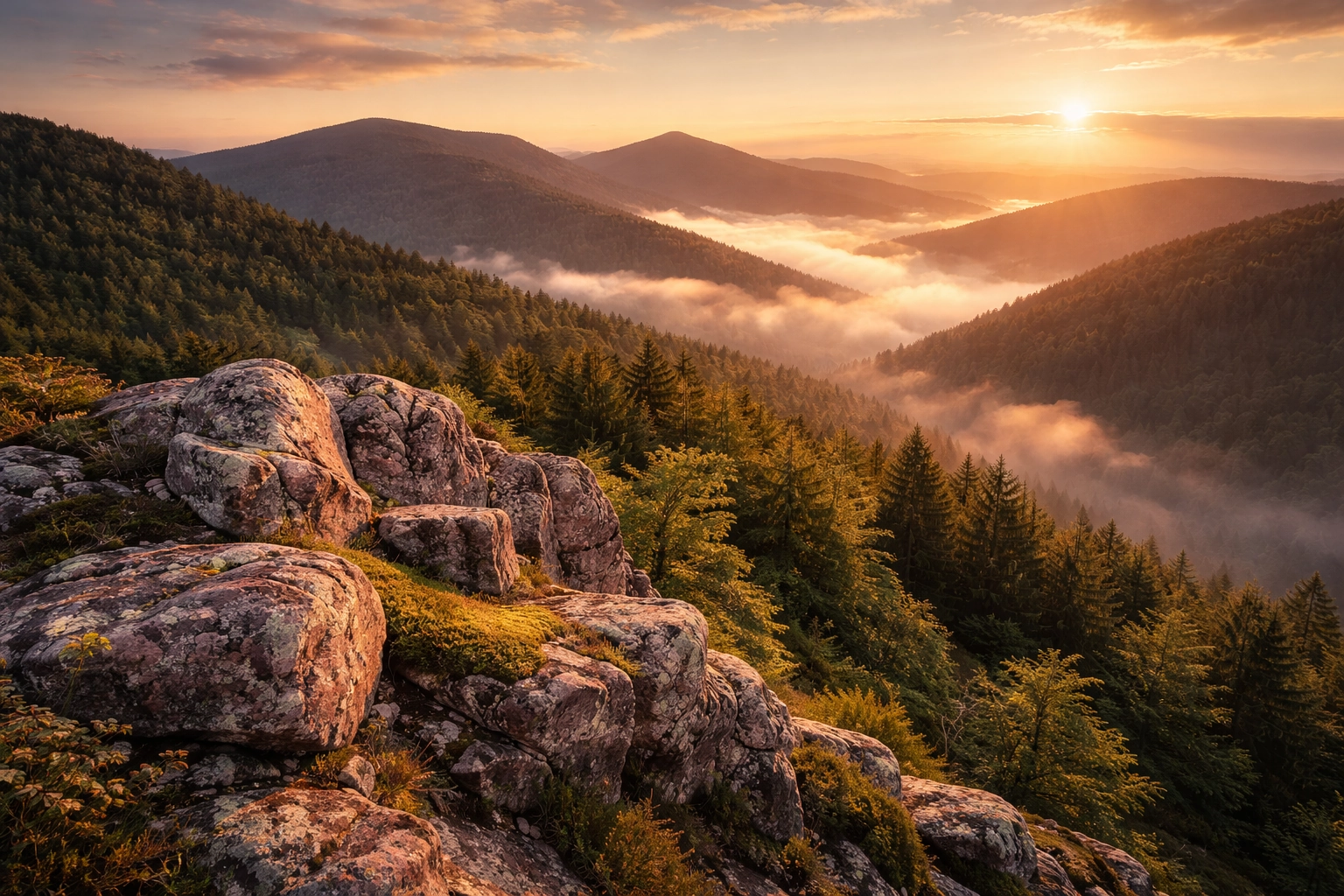
Vosges ridgelines at sunrise — pink sandstone cliffs and ancient rounded summits

Telluric Sites in the Vosges

Ancient Hercynian Massif, Pink Sandstone Stratification and Rhine Rift Architecture

The Vosges Massif represents one of the oldest geological structures in France. Unlike the vertical compression of the Alps or the volcanic dynamism of the Massif Central, the Vosges express telluric intensity through erosion, stratification and crystalline permanence.

Here, geological memory is not expressed in dramatic peaks, but in rounded summits, pink sandstone cliffs, and deep crystalline roots exposed over hundreds of millions of years.

Hercynian Origins and Crystalline Basement

The Vosges originated during the Hercynian orogeny approximately 350 million years ago. This Paleozoic mountain chain was once comparable in scale to modern high ranges. Over geological time, erosion progressively reduced its relief, exposing deep granitic and metamorphic cores.

Today, granite and gneiss form the crystalline backbone of the massif. These rocks resist erosion and maintain structural coherence, ensuring long-term mineral visibility.

The massif therefore represents an ancient tectonic memory, stabilized yet still readable in landscape orientation.

The Pink Sandstone of the Vosges

During the Triassic period, sedimentary deposits accumulated along shallow continental basins. These deposits later consolidated into the characteristic pink sandstone of the Vosges.

Iron oxide within the sediment matrix gives the stone its distinctive ferruginous coloration. Horizontal stratification remains clearly visible along cliffs and rock tables, particularly in the northern Vosges.

This stratification produces natural terraces and tabular formations, distinct from the crystalline summits further south.

Ballons and Rounded Summits

The Vosges summits, known as “ballons,” exhibit rounded morphology shaped by prolonged erosion and glacial smoothing. The Grand Ballon stands as the highest point of the massif.

Unlike the sharp ridges of the Alps, Vosgian relief is smooth yet structurally dense. This morphology enhances telluric perception through continuity rather than vertical aggression.

Open high-altitude meadows, known as “chaumes,” provide panoramic exposure of the mineral substrate.

The Rhine Rift and Structural Contrast

The western boundary of the Rhine Rift Valley dramatically defines the eastern slope of the Vosges. Tectonic subsidence created the Alsace plain, while the Vosges remained relatively uplifted.

This fault system produces a sharp contrast between mountain and plain, enhancing structural readability.

Regional comparison: Telluric Sites in Alsace

Quartz Veins and Mineral Visibility

Quartz veins frequently intersect Vosgian granite. These crystalline inclusions reflect sunlight, increasing mineral luminosity along exposed ridges.

Quartz concentration reinforces the perception of density and cohesion, especially where vegetation cover is limited.

Similar crystalline dynamics are observed in Brittany, though expressed in granite plateaus rather than sandstone ridges.

Telluric Criteria in the Vosges

Altitude alone does not define telluric intensity. Mineral exposure and structural legibility remain decisive.

Comparison with Other French Telluric Regions

The Vosges differ structurally from other French regions:

The Vosges represent an intermediate model: ancient, eroded, yet structurally persistent.

Geological Permanence and Contemporary Mineral Form

The continuity of crystalline structure in the Vosges parallels the logic of monolithic sculpture: compression, mineral density, and stratified integrity.

While natural erosion shapes rounded summits, contemporary sculptural practice refines mineral mass into geometric clarity.

Explore mineral continuity in Quartzite Sculpture.

Extended FAQ — Vosges Telluric Sites

Are the Vosges older than the Alps?
Yes. The Vosges formed during the Hercynian orogeny hundreds of millions of years before the Alpine collision.

Why is Vosges sandstone pink?
Iron oxide within the sediment gives the stone its ferruginous coloration.

Is the region still tectonically active?
Moderate seismic activity persists due to adjustments along the Rhine Rift system.

Do the Vosges qualify as high telluric sites?
Yes, due to exposed crystalline basement, sandstone stratification and tectonic fracture visibility.