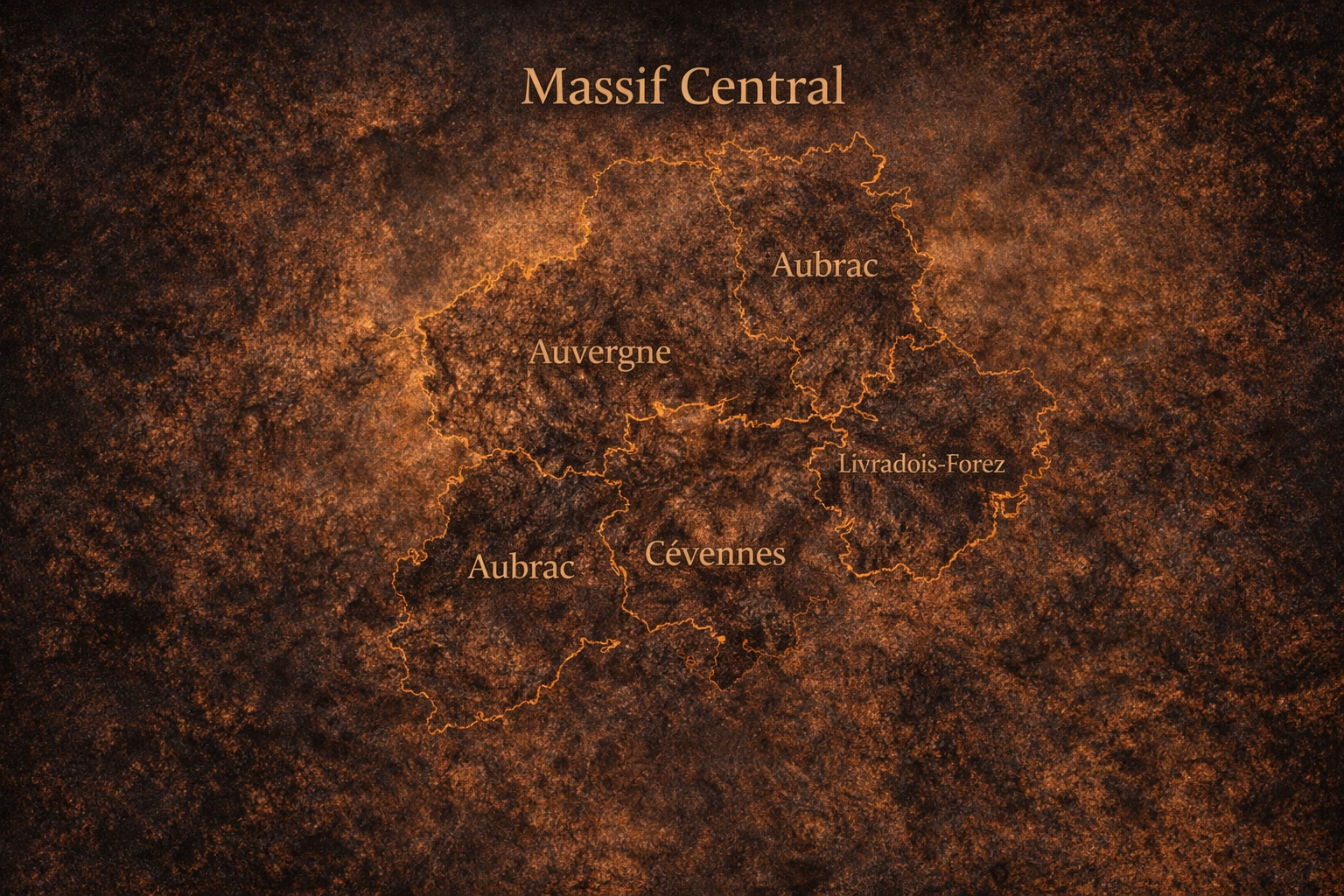
Volcanic domes of the Massif Central at sunrise — basalt columns and Auvergne plateaus

Telluric Sites in the Massif Central

Volcanic Uplift, Basalt Density and Geological Verticality

The Massif Central represents one of the most structurally powerful geological territories in France. Unlike the granite plateaus of Brittany, its telluric identity emerges from volcanic construction, tectonic uplift and dense basaltic architecture.

Here, the Earth’s internal processes are visibly inscribed in the landscape: solidified lava flows, trachytic domes, radial erosion patterns, and columnar basalt formations.

Hercynian Basement and Tectonic Reactivation

The Massif Central rests on an ancient Hercynian crystalline basement formed over 300 million years ago. This Paleozoic orogenic system created a mountain chain that was later deeply eroded.

During the Cenozoic era, tectonic extension related to the opening of the Rhine Rift system reactivated fractures within this basement. These lithospheric weaknesses enabled magma ascent.

The region therefore expresses layered geological time: ancient compressed crust overlain by relatively recent volcanic construction.

The Chaîne des Puys — Linear Volcanic Alignment

The Chaîne des Puys forms a remarkable alignment of more than 80 volcanic edifices. These structures include strombolian cones, trachytic domes, and explosion craters (maars).

Their alignment reflects tectonic fracture orientation. Volcanic vents exploited pre-existing fault lines.

The Puy de Dôme dominates the chain, its trachytic dome rising prominently above surrounding plateaus. Its isolated geometry reinforces vertical telluric perception.

National context: telluric sites in France.

Basalt Columns — Natural Mineral Architecture

Columnar basalt forms when lava cools and contracts. Thermal contraction creates polygonal fracture patterns, often hexagonal in section.

These vertical columns resemble deliberate architecture. Yet they result from purely physical processes: cooling dynamics, fracture propagation, and crystallization.

Basaltic verticality constitutes one of the strongest visual markers of telluric intensity in central France.

The Cantal Stratovolcano — Radial Erosion and Layered Mass

The Cantal massif represents the remnant of one of Europe’s largest stratovolcanoes. Successive lava flows built a massive volcanic edifice.

Erosion progressively sculpted radial valleys, revealing stratified volcanic layers.

This large-scale geomorphology transforms the entire landscape into a readable geological section. The mineral mass remains visible at territorial scale.

Puy de Sancy and High Volcanic Relief

The Puy de Sancy, highest summit of the Massif Central, embodies volcanic uplift combined with glacial reshaping.

Steep slopes, exposed rock faces, and panoramic horizon exposure contribute to high telluric readability.

Unlike the compressive verticality of the Alps, the Massif Central expresses constructive verticality — built by magma rather than plate collision.

Planèzes and Volcanic Plateaus

The planèzes of Cantal represent broad volcanic plateaus formed by stacked lava flows.

Their gently inclined surfaces contrast with deeply incised valleys. This juxtaposition of horizontal basalt sheets and radial erosion enhances structural legibility.

Such geomorphology differs fundamentally from the granite chaos of the Vosges.

Volcanism and Telluric Criteria

Telluric perception in the Massif Central derives from visible volcanic construction, not symbolic attribution.

Volcanic Stone and Contemporary Monolithic Form

Basalt, trachyte, and volcanic rock embody compression, density, and structural cohesion.

The transition from natural volcanic mass to sculptural monolith follows the same logic: material density structured into geometric clarity.

Explore the mineral dimension through Quartzite Sculpture.