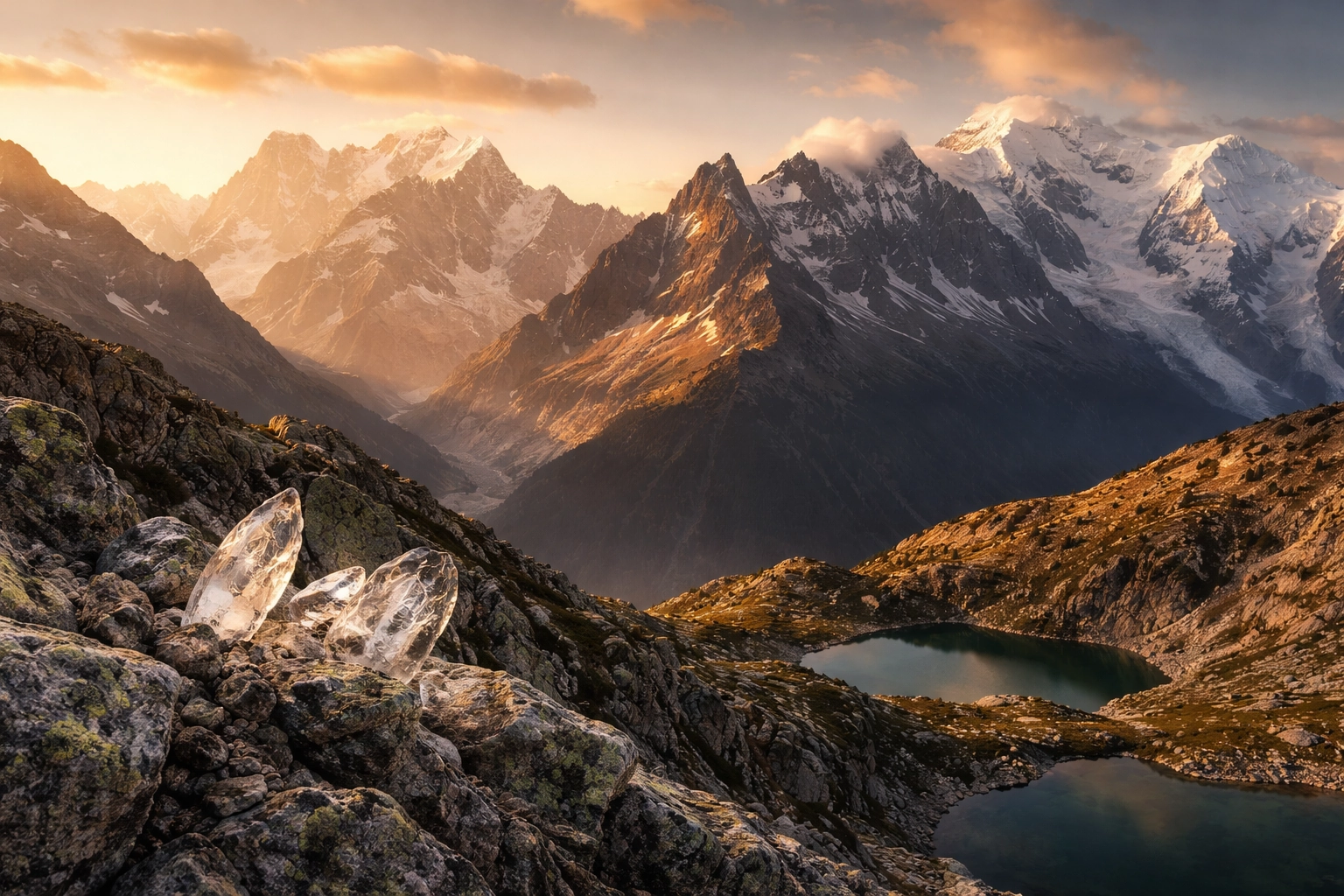
The Alps stand as one of Europe’s most remarkable examples of tectonic collision and lithospheric architecture. Formed by the convergence between the African and Eurasian plates, the Alpine region exhibits strong vertical relief, exposed crystalline cores, and complex structural patterns that qualify it as a primary telluric territory in France.
This encyclopedic analysis explores the geological frameworks, rock formations, and spatial dynamics that define Alpine telluric landscapes.
The Alpine orogeny began approximately 65 million years ago as the African plate collided with the Eurasian plate. This collision generated extraordinary compressive forces that uplifted sedimentary sequences and crystalline crust into towering mountain chains.
The entire Alpine arc showcases stacked rock units, nappes, fold systems, and thrust faults that record millions of years of crustal deformation and uplift.
Exposed rock faces, ridgelines, and high summits reveal layers that were once buried deep within the Earth’s crust.
At the heart of the Alpine massif lies high-grade metamorphic rock: gneiss, schist, and granite. These rocks originate from deep crustal levels and possess exceptional mineral density.
Crystalline cores appear as massive outcrops at summits and ridge lines, revealing the deep architecture of tectonic uplift.
Quartz, feldspar, mica and accessory minerals form large, coherent crystalline frameworks that resist erosion and maintain structural visibility.
Several landforms in the Alps exhibit strong telluric characteristics:
These features combine structural exposure with high relief contrast — the essence of telluric visibility.
Although less concentrated than in Brittany, megalithic remains are present in the Alpine foothills and plateaus. Their location often corresponds to accessible rock formations and tectonically stable ground.
The proximity of large stone blocks, ease of transport along glacial valleys, and availability of exposed rock influenced settlement locations during prehistoric times.
Throughout the Quaternary, Alpine glaciers carved deep valleys and exposed bedrock on a massive scale. The weight and movement of ice removed overlying sediments, leaving bare rock surfaces that remain visible today.
This glacial sculpturing intensifies telluric perception by increasing rock-to-soil ratio on slopes and summits.
Alpine geology is heterogeneous, including:
Each rock type contributes to a distinct telluric reading depending on exposure, orientation, and landscape context.
These criteria combine in the Alps to produce some of the most visible and readable telluric landscapes in France and Europe.
The Alpine telluric structure differs from other regions:
The Alps stand out due to vertical tectonic compression rather than plateau exposure.
The Alpine structural principles — compression, density, crystalline coherence — find conceptual resonance in contemporary stone sculpture.
Vertical forms, sharp ridges, and geometric clarity in sculpture echo the hidden tectonic architecture visible in Alpine summits.
Explore related sculptural practice in the Quartzite Sculpture section.